

We meet Therese Weber in her studio in Hergiswil, housed in a former industrial building. Flooded with natural light, the spacious atelier feels like a world unto itself. Handmade papers, books, sketches, pigments, and works in progress share the space with an extraordinary collection of objects gathered over decades of travel and research. Artifacts, tools, textiles, natural materials, and mementos from different cultures reveal the artist's enduring fascination with the histories, traditions, and knowledge systems that shape human experience.
The studio functions both as a workspace and as a laboratory of ideas. Here, artistic production, research, and experimentation converge. Every shelf, table, and wall bears traces of journeys undertaken in pursuit of knowledge-from papermaking workshops in Japan and China to expeditions through the Caucasus and other regions where cultural memory, craft traditions, and material histories remain deeply embedded in everyday life.
For more than four decades, paper has been at the heart of Weber's artistic practice. As one of the pioneers of Paper Art, she has developed a distinctive artistic language that combines material experimentation with cultural research. Her work explores the history of paper, the transmission of knowledge, and the relationship between nature, memory, and human creativity.
In the following interview, Therese Weber reflects on her artistic journey, her formative experiences in the United States and Japan, the role of research and discovery in her practice, and the enduring relevance of paper in an increasingly digital age.
171 GALLERY: Paper is at the center of your artistic practice. What fascinates you about this material, and what artistic possibilities do you continue to discover in it?
Therese Weber: What fascinates me most about paper is its art-historical significance and its deep roots in the cultures of Asia, India, and other parts of the world. Researching and exploring these traditions has become a continuous thread throughout my life. It has influenced my artistic work and forms the basis of my global network in the arts, opening up opportunities for international collaboration.
It is not paper itself that is central to my work, but rather the highly individual techniques and processes I have developed. These ultimately lead to the creation of an image, a painting made from paper fibers, or a paper sculpture. My works are created through layers of previously dyed natural fibers sourced from materials such as mulberry bark, abaca-also known as Manila hemp or banana hemp-as well as bamboo, cotton, and other plant fibers.
Every raw material used in papermaking has its own characteristics and properties, including opacity, tensile strength, stability, hardness, and much more. These are primarily technical and ecological aspects that influence the creative process and continually challenge the skills and experience I have developed over many years.
In this sense, I also view my studio as a laboratory for experimentation, because every new concept requires different methods and forms of realization. These phases are demanding but also exciting. Time and again, I find myself back at the starting point, at the beginning of a path that must first be conceived and shaped. Whether the intended goal will ultimately be achieved remains uncertain; it depends on many factors and decisions along the way.
171: What motivated you to go to the United States in the early 1980s and engage with the Paper Art movement?
TW: The distant horizon was calling, and the move represented a continuation of my studies, which had already offered several interesting points of connection. I only encountered Paper Art once I was in California. Before arriving, I had little idea of how profoundly my time in Berkeley and San Francisco would influence my future path.
That period also brought encounters with already established artists such as Nance O'Banion, Neda Al-Hilali, and my teacher Don Farnsworth.
The energy and pioneering spirit of those years were immense, and the exchange of ideas was enriching. We all shared the same goal, yet we were not competitors. As a young artist from Switzerland, I experienced a great deal of generosity. The challenge was mine-to embrace the openness and opportunities of this artistic community while also meeting its demands.
Those years were formative and ultimately led to my subsequent stays in Japan.
171: Certain aspects of your artistic language evoke associations with artists such as Howardena Pindell, an important figure in Paper Art. What role did artists of the Paper Art movement play in the development of your own artistic language?
TW: As one of the pioneers of Paper Art myself, and at a time when the discipline was still in its infancy, there were very few points of reference. For me, this was actually an advantage-even a stroke of luck-because it allowed me to develop my own methods and discover my own distinctive artistic language.
My primary sources of inspiration were often women artists working in other artistic disciplines. What inspired me was not only their work but also their philosophies of life.
I had already encountered important artistic personalities through the New York art scene. Particularly influential were Georgia O'Keeffe and Louise Nevelson, both of whom I had the opportunity to meet. Another important figure was Golda Lewis and her fascinating project Sidewalks of Manhattan. I later collaborated with her as well.
Through Paper Art, connections and friendships emerged that have endured across generations and transcend geographical boundaries.
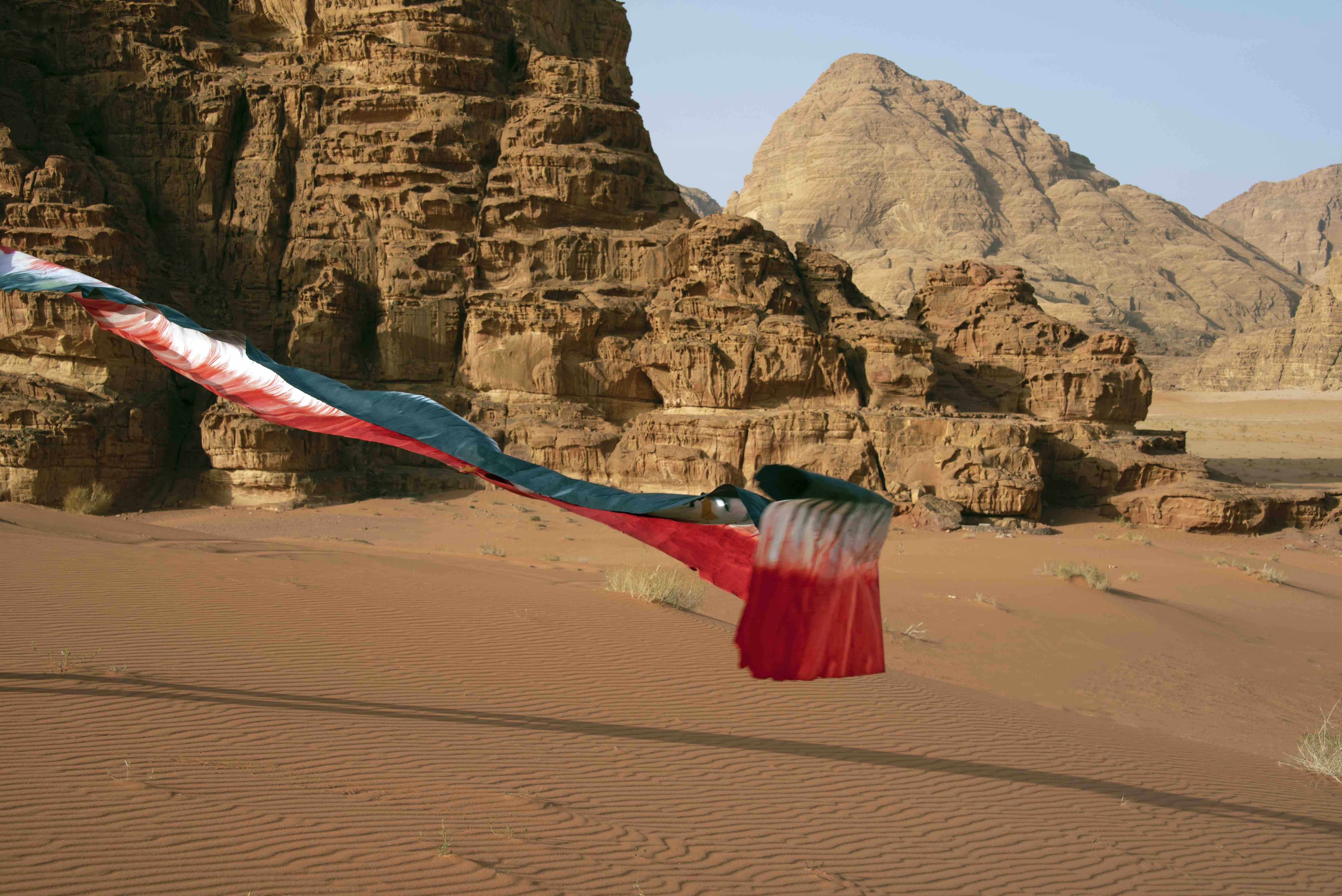
Units of Sediments and Materiality V, 2022, Performative intervention, Wadi Rum, Jordan, Dyed mulberry fiber paper ribbon, 45 × 2500 cm, Photograph, 50 × 70 cm, Photo: Therese Weber
171: Which impressions and experiences from your time in the United States had the greatest impact on you?
The critical and intellectually stimulating discussions, the collaboration with print workshops, and the power of open dialogue were particularly influential. Visits to museums and their extraordinary collections were equally enriching.
171: After your time in the United States, how did you experience the Swiss art scene of the 1980s, particularly with regard to opportunities and visibility for women artists?
TW: The work of women was often categorized simply as "women's art," especially when it did not conform to traditional painting. Skepticism was part of everyday life.
Collectors and gallery owners generally favored the work of male artists. They were seen as more likely to succeed in the complex and highly competitive art world. Women faced enormous pressure to establish the same image and earn the same level of respect and acceptance.
Of course, there were exceptions, such as Meret Oppenheim, Eva Hesse, and others who benefited from social and artistic environments that actively supported their careers.
My own path was marked by highs and lows, by periods of success and periods of little recognition, by critical judgments as well as constructive feedback. Through often intense discussions with gallery owners and artists, however, I was able to gain considerable acceptance and encourage a shift in perspective, leading to a greater inclusion of women artists within exhibition programs.
171: What sparked your interest in Asian culture?
TW: I was drawn to the appreciation of materials, the intention behind artistic practice, the dynamism, and the concentration required in calligraphic drawing and painting. I was also fascinated by the deep-rooted awareness of tradition, the sensitivity and openness to different perspectives, and the ability to distinguish between subtle nuances of thought and expression.
The language itself was inspiring, as were the written characters associated with it and the finely structured Japanese color woodblock prints. I was equally captivated by the aesthetics and precision found in both art and craftsmanship-for example, in the construction of traditional architecture, with its shojis and fusumas, paper sliding doors that divide and transform interior spaces.
171: You have worked extensively in Asia, particularly in Japan, where many of your Pulp Paintings were created. How did these periods of work in Japanese studios shape your artistic practice?
TW: My first experiences in Japan date back to 1984. I spent more than three months traveling through the country. Arriving in a small village north of Tokyo felt like stepping into an entirely unknown world. Surrounded by rice fields, I encountered traditional Japanese daily life firsthand.
Living in a straw-roofed house with an open hearth at its center, tatami floors, and paper sliding doors that could divide the open interior into different spaces was a formative experience.
What remains most vivid in my memory are the encounters with people, places, and cultural traditions. One example is the Fujiimori family at the Awagami Factory in Tokushima. The large-scale works currently exhibited at Gallery 171 were created there during an artist residency in 2023. During that time, I lived and worked in relative isolation, focusing entirely on my artistic concept.
Near the factory are small temples surrounded by magnificent gardens-spaces of tranquility and concentration. Looking out toward the surrounding hills, one sees mixed forests in countless shades of green, their colors constantly changing with the light. It was a period of retreat into my own perception, into spaces of reflection, and into the culture and history I wished to explore.
For me, art is a process-movement, attention, and research. It is about finding answers to complex questions and generating knowledge and insight.
A very different experience was Tokyo itself, vibrant and colorful, where in 1986 I participated in the exhibition Constellations: Aspects of Contemporary Swiss Art at the Hara Museum of Contemporary Art.

Artist Therese Weber at work in Japan. Photo courtesy of the artist.
171: How do you combine paper and photography in your work?
TW: Initially, I used photography as a visual aid for my journals or as a way of capturing a specific moment in time. As my research developed, photography evolved into a documentary tool.
Its integration into my artistic process emerged through installations and performances in public space, where it serves to capture and document ephemeral actions-the image of a moment that would otherwise disappear.
171: In addition to your artistic work, you are also an author. What inspired you to write the book The Language of Paper: A 2,000-Year History?
TW: While traveling through China, often on endless journeys along rough and uneven roads, I became increasingly aware that our understanding of paper is largely shaped by its industrial production for everyday use.
Through my research and fieldwork, however, my knowledge of paper's cultural, technical, ecological, and material dimensions had developed to a completely different level. I wanted to share and communicate that knowledge.
The publisher was enthusiastic, and an English edition followed shortly afterward. To this day, the book remains a standard reference work. Before that, I had already published Washi - Past and Present of the Japanese Papermaking Tradition, a bibliophilic volume bound in the traditional Asian block-binding method.

The Language of Paper: A 2,000-Year History by Therese Weber. Book cover. Photo courtesy of the artist.
171: What significance does the history of paper have for contemporary art?
TW: The earliest paper provided the foundation for the dissemination of knowledge. Because it could be produced in larger quantities, it represented a major milestone in the transmission of text and images-and therefore also in the development of free thought and opinion.
Before paper, clay tablets, parchment, and papyrus served as carriers of text and imagery, but these materials were available only in limited quantities.
In contemporary art, we also seek to communicate our message-to draw attention to specific contexts and to address issues that matter to us.
171: What role do discovery and research play in your creative process?
TW: For me, art is also a process of gaining knowledge and expanding understanding. Research and discovery are therefore essential. This includes exploring the past in order to reflect on connections and comparisons with present-day events.
This is especially relevant in the context of climate change, armed conflicts, developments in art history, and the emergence of AI-generated images and texts.
Such thematic contexts can support and sharpen the creative process, helping to focus artistic inquiry and expression.
171: How do you see the future of your artistic work? Are there particular themes or projects that interest you in the coming years?
TW: In recent years, rock art-particularly petroglyphs, prehistoric languages, symbols, and figures engraved into stone-has become an important focus of both my scientific and artistic research.
This field spans numerous continents and cultures, and there is still much to discover. I would also like to continue developing book projects while allowing myself ample time, both in the studio and on research expeditions, to explore and deepen new ideas.
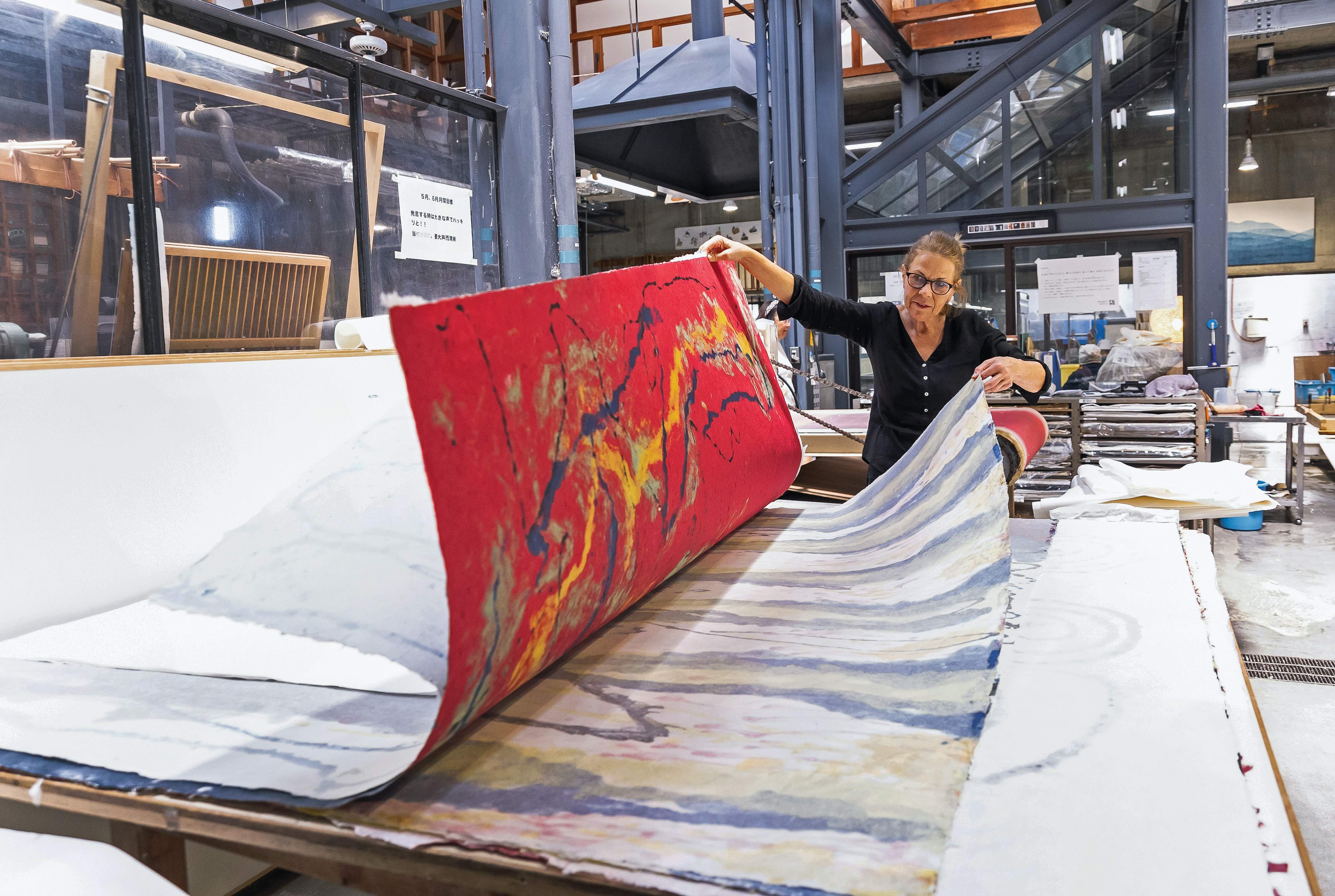
Artist Therese Weber at work in Japan. Photo courtesy of the artist.
171: Can you imagine working more extensively with other materials or media in the future, or will paper remain your primary means of expression?
TW: Glass is a material that greatly interests me. I am fascinated both by its malleability under heat and by the way pigments can be introduced into the molten material, becoming permanently embedded before it solidifies.
171: What role might new technologies or digital media play in your future artistic practice?
TW: The tactile quality of an artwork will remain important to me. Collectors are often fascinated by physical characteristics such as textures, structures, or deckled edges. These sensory elements reveal something about the materiality of the work itself.
I value originals in which the artist's identity-their unique "fingerprint"-is unmistakable.
Digital media possess a certain seductive quality because they can be manipulated almost without limits, depending on the user's level of expertise and familiarity with digital tools and AI programs.
I use such technologies where they make sense to me-for example, where they can support and simplify management processes. As my "right hand" within the artistic process, however, they are too arbitrary, too easily manipulated, and too detached from the meaning and sensitivity that I seek within my oeuvre.
171: How important is it for you to continually transform and develop your artistic practice?
TW: It is absolutely essential. New questions emerge through the process itself, and working through themes, methods, and techniques creates a rich reservoir for future projects and stimulates new forms of discourse.
In my artistic practice, I seek to acquire diverse strategies, connect different bodies of knowledge, question and investigate new systems of meaning, and reflect upon them.
Why would I dedicate my life to art if it did not move me forward-if it did not allow me to expand and deepen my ways of thinking, my knowledge, and my skills?

Installation view of Topografien der Räume in the exhibition PAPER ART, Birsfelder Museum.
171: Finally, what new projects are you currently working on, and what can we look forward to in the future?
TW: My newest works are titled The Song of the Glacier. They are based on my experiences in the Arctic. These are smaller-scale objects characterized by a dense and vibrant use of color.
I will present them for the first time at Volta Art Basel in June, and I am very curious to see how they will be received. I look forward to the conversations and encounters that will follow.
