


We visited Sara Gassmann in her studio overlooking the railway lines of Bern Wankdorf in advance of her forthcoming solo exhibition, Lightnings. Monolog eines Innenraums. The luminous workspace is densely populated with books, objects, sculptural elements, as well as her paintings and ceramic works, offering insight into a practice grounded in material sensitivity and sustained perceptual inquiry.
The studio functions as a site of research rather than mere production. Works in progress are arranged in constellations that foreground relational thinking across media. Canvases alongside glazed and unglazed ceramic surfaces articulate an approach in which material conditions actively inform compositional decisions. Gassmann's process is guided by intuition, yet remains critically attentive to formal balance, spatial organization, and chromatic precision.
Recent works signal a pronounced engagement with interior space as both a formal and conceptual framework. Architectural fragments and still life elements are detached from functional or narrative contexts and reconfigured as autonomous pictorial structures. These interiors operate as mental constructions, evoking psychological states rather than descriptive environments. Rather than enclosing the viewer, they propose open perceptual fields characterized by restraint, permeability, and temporal suspension.
171 GALLERY: Your practice is often described as an open process guided by intuition and perceptual responsiveness rather than a fixed intention. How do you recognize the moment when a work reaches its own internal balance or coherence?
Sara Gassmann: It is a feeling that tells me the work is resolved. In this moment of completion, everything revolves around color, about the constellations in which tones encounter one another, the proportions in which they appear, and the tension they generate while still acting harmoniously as a whole. Because I work with many translucent layers, it is difficult to correct a composition that does not feel convincing. In rare cases I succeed. Otherwise, I remove the canvas from the stretcher and begin again. Time is another decisive factor. During the process I often lack the distance necessary to judge whether the image meets my own standards. For this reason I usually work on several pieces simultaneously. This allows me to step back repeatedly while remaining immersed in the flow.
171: Color in your paintings and ceramic works appears almost as a living substance. What role does color play in shaping space, atmosphere, and emotional resonance in your work?
SG: Everything serves color and its application. Forms are necessary as vessels, but they exist in support of chromatic presence. Pigments possess their own momentum and often escape rational control. My sensitivity to tonal relationships and neighboring hues is deeply rooted within me. Exploring and reinventing combinations is my greatest passion and one of the reasons for my chosen media.

POINTING MEMORIES, 2023, glazed ceramic, Kunstmuseum Luzern, Photo: Marc Latzel
171: For a long time, organic and corporeal references often resembling animal bodies or fragments have appeared in your compositions. What draws you to these ambiguous forms that hover between abstraction and recognition?
SG: The basis of my vocabulary lies in sketchbooks that function as a dynamic archive. I draw the shapes that attract me quickly and intuitively. They later become the source material for the paintings. A translation already occurs at that stage, a first movement toward abstraction. Certain motifs reappear. Although the archive continues to grow, it also follows cycles governed by attraction and desire. Hands, feet, nails, and their textures hold my gaze. I am fascinated by the analogy to bird claws. Through my study of palmistry I explored this interest more deeply. These fragments emerged because they were the parts that most captivated me and therefore entered the notebooks.
Animals entered the work differently. I have always loved drawing birds, perhaps influenced by my father, who admires them deeply. Many animals and hybrid beings appeared when I learned tattooing. I wanted to develop my own subjects, protective creatures. During that period I drew and tattooed numerous animals and hybrid forms and translated them onto canvas and ceramic. The shapes act as containers that are filled by chromatic constellations with new narratives while resisting direct storytelling.
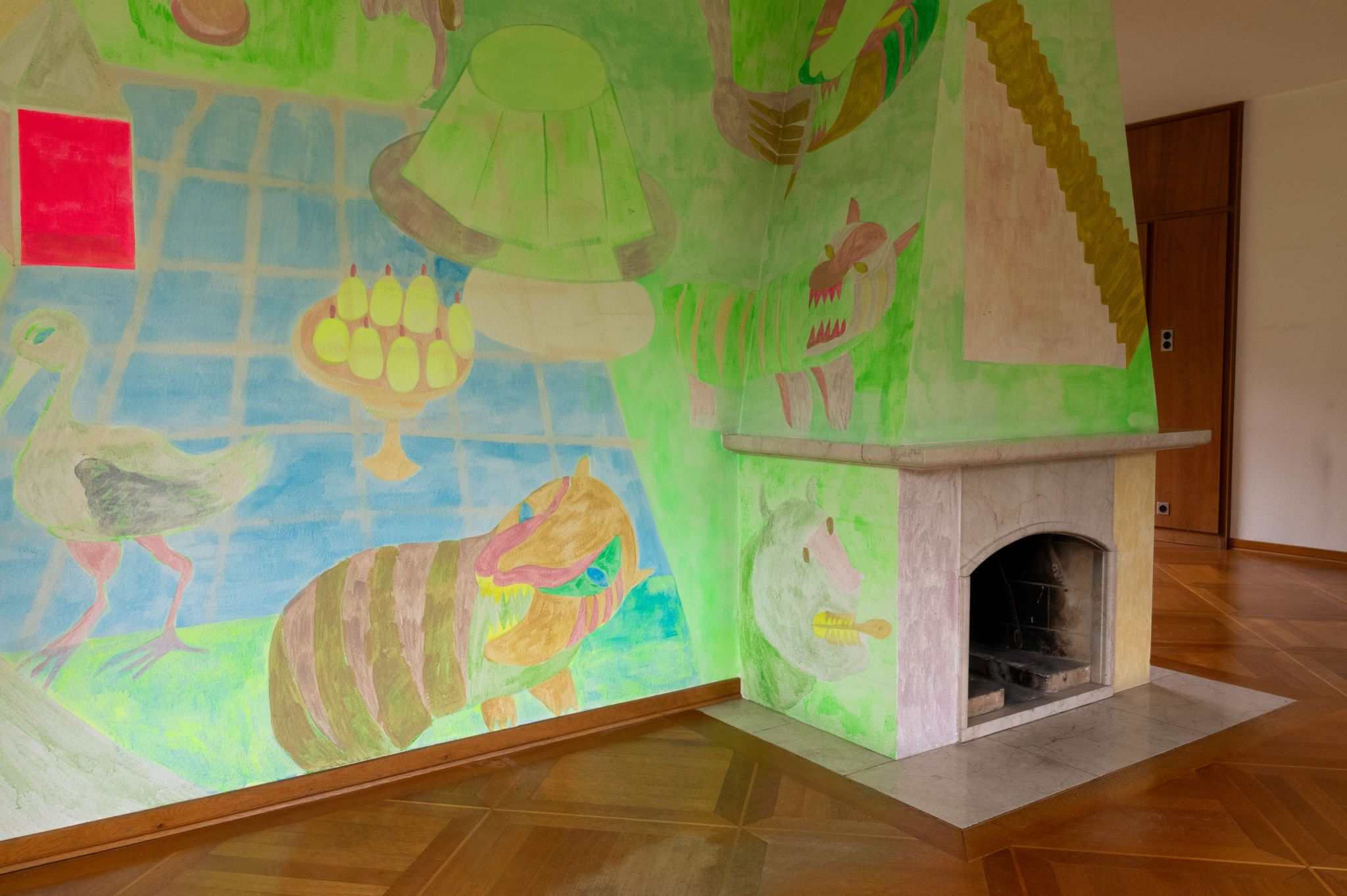
COMING TOGETHER, 2025 acrylic on wall, Photo: Samantha Zaugg
171: The tiger is a recurring figure in your work. You generally avoid anthropomorphic imagery. What draws you to animals as presences in your practice, and why has the tiger become a specific point of focus?
SG: Animals often carry attributes and convey a distinct energy. I first encountered the tiger intensely in Korea. During a residency in Seoul I was captivated by ink depictions of Korean tigers. Since then I have returned to this figure in various ways. Beyond its formal appeal, it embodies a way of inhabiting the present. The tiger waits patiently, endures, and when the moment arrives it acts decisively. I value this reminder in daily life, to accept circumstances as they are and to respond with courage when required. In the series le tigre this presence also introduced a new ease into my approach.

LE TIGRE 5, 2025, acrylic, ink on cotton, 140 x 120 cm
171: In your more recent works, interior spaces and still life motifs have come into focus. What motivated this shift? How did Japanese woodblock prints influence this body of work? And how do you understand the notion of interior in relation to the exhibition title Lightnings. Monologue eines Innenraums?
SG: This development was not consciously planned. My fascination with Japanese woodblock prints encountered in exhibitions and catalogues gradually filled my sketchbooks with related elements. In lively scenes populated by figures I found myself drawn primarily to the architectural structures and objects such as gates, stairs, and ladders. These elements functioned beautifully as chromatic containers. Only when translating them into painting did I recognize that they resembled a form of still life radiating calm and clarity. In their interaction I sense an inner vastness that can expand endlessly.
At the same time I felt a personal need for order, tranquility, and reduction to essentials. This formal clarity corresponded with an inner process. I was reflecting on the expansion of my own interior spaces. Realizing that boundaries can be placed externally and that inner space can thereby grow was illuminating. When I acknowledge my needs and stand up for them, this internal architecture expands.
Stairs and gates relate to transitions, a subject that has long interested me. These may be everyday shifts from one activity to another or natural cycles such as day and night, the seasons, the beginning and end of life. I never consciously attempted to represent these themes. They simply existed within me. Only later did I understand that these forms were all elements of passage. They became visible, yet remain vessels while color continues to guide the composition.
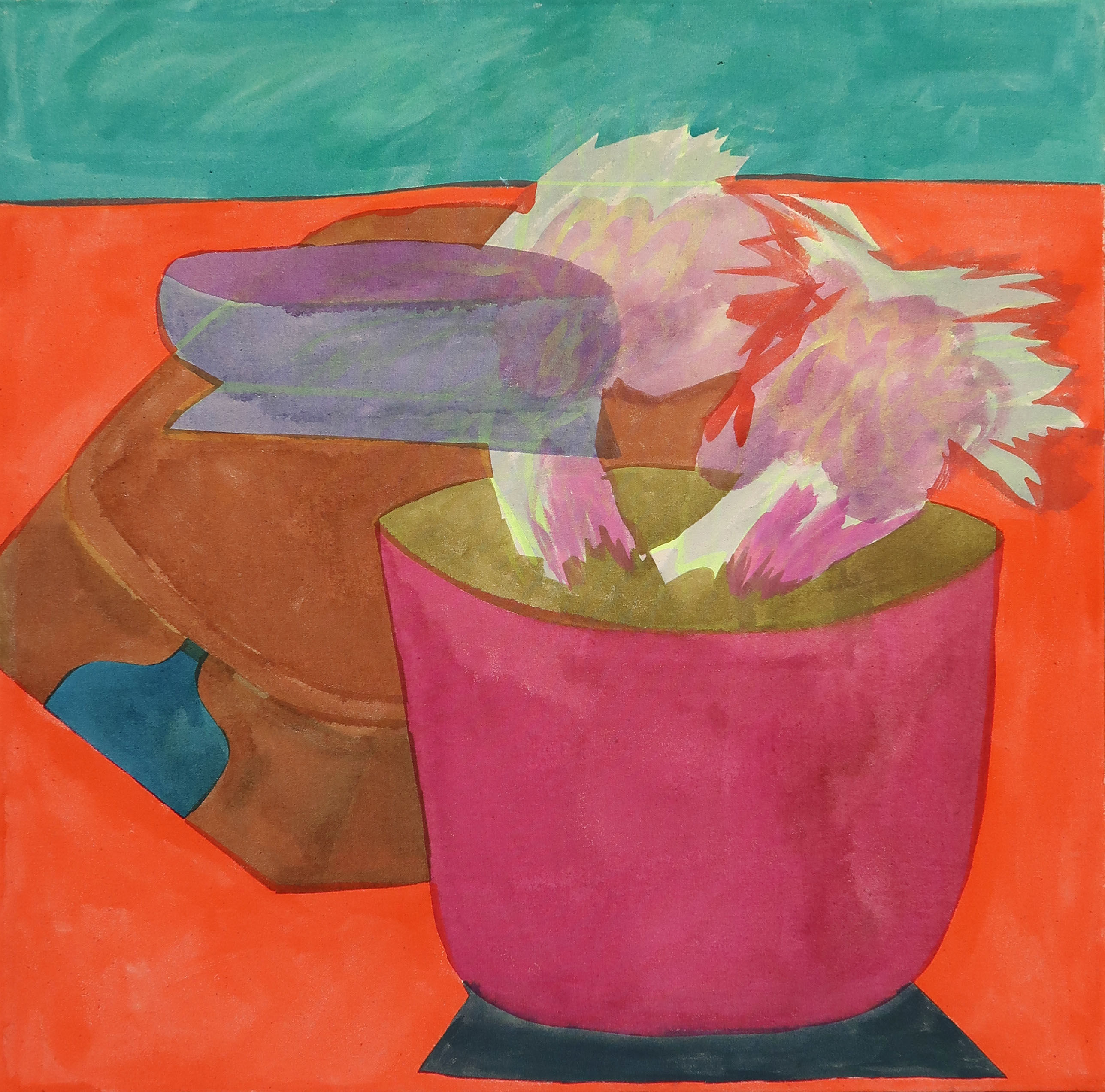
Lightnings 12, 2025, acrylic, ink on cotton, 65 x 65 cm
171: The spaces in your works do not follow stable spatial logic. How do you develop this internal ordering within the image?
SG: The process is intuitive. Forms from the sketchbooks initiate the composition and gradually enter into relation with one another. An interaction unfolds and color begins to dominate. In a certain sense I surrender to it.
171: Objects such as bathtubs, tables, vessels, and containers recur in this series, yet they are detached from their everyday function. What interests you in these objects once removed from practical use?
SG: They are containers whose silhouettes fascinate me, while their original meaning becomes secondary. What remains essential is the chromatic narrative that emerges. Details gain significance, for example the legs of tables or vessels, and flowers arranged in the spirit of Ikebana. These are not mere decorations but stand for harmony and respect for natural cycles. I value flowers deeply because they embody transition so clearly.
171: Compared to earlier works, this series avoids dense layering and bodily presence. What possibilities did this reduction open up, and how does emptiness function within these spaces?
SG: Clear boundaries without layered surfaces and without physical presence create a sense of spatial expansion. The viewer can inhabit these areas and at the same time be animated by them. Reduction becomes vibrant through the interaction of hues.
171: Materiality plays a decisive role in your process. How do canvas and ceramic actively shape your compositional decisions?
SG: Canvas and ceramic are my primary materials and they enrich one another. Working on canvas is done standing. Several pieces hang side by side on the wall. There is a constant movement between proximity and distance. I mix tones as I imagine them and the result appears immediately. I prepare a light cotton with transparent skin glue that seals the pores and allows the paint to flow smoothly. This surface suits my watercolor-like approach using ink and diluted acrylic.
Working with clay is done seated and feels more intimate and concentrated. The principle is related. On leather-hard clay I draw the forms with underglaze. After the first firing the glaze is applied in broader areas. I anticipate the result mentally and have a sense of how it might appear, though a certain unpredictability remains. This experimentation leads me toward new tonal constellations.
171: The interiors you depict feel permeable rather than closed. Can the interior be understood as a space of expansion rather than withdrawal?
SG: It can be both, depending on how retreat is defined. A place of refuge can exist within. When I communicate my boundaries clearly and do not confine myself inwardly, my inner spaces can expand and become shelter. Contemplating painting can function in a similar way and may open new inner dimensions.
171: Many of your works evoke a sense of suspended or slowed time. How does temporality factor into your process, and how might viewers experience time while engaging with the works?
SG: While painting, I experience a different quality of time. It stretches and at the same moment erases any awareness of duration. When I return to everyday life, I often realize that hours have passed. I appreciate the thought that this altered temporal perception, which is visually anchored and difficult to articulate, might also reach those who encounter the work.
171: Your experience with shadow puppetry in Bali introduced questions of visibility, absence, and transformation. Do these ideas continue to inform your thinking about space and image?
SG: Shadow puppetry fascinated me formally. I had the opportunity to learn from an experienced Dalang who introduced me to the technique and the performative tradition. These presentations, often embedded in ceremonial contexts, recount the Ramayana and reveal human shadows in a theatrical manner accompanied by Gamelan music. The confrontation with shadow, both formally and conceptually, remains compelling. What is visible and where does shadow appear? Do I perceive my own shadow? Many of my figures contain their shadow within themselves. They are dual and do not require an adversary.
171: Your images resist immediate legibility and invite attentive looking. What kind of perception do you hope to activate in the viewer?
SG: I hope to awaken intuitive and emotional perception, a space in which multiple readings are possible and no interpretation is fixed. This intention also informs my titles. I avoid limiting the experience of looking and only rarely repeat what is already visible, as in le tigre.
171: When someone leaves the exhibition, what would you like to remain with them?
SG: Each response will be individual. My intention as an artist is to create nourishing work that opens a space in which one feels comfortable lingering.
171: After this sustained focus on interior spaces, what directions do you see emerging next in your practice?
SG: At present I remain deeply immersed in this subject and cannot foresee its conclusion. I will sense when change becomes necessary. New directions often arise through pauses or through engagement with externally defined projects, such as designing a children's board book or contributing to an art and architecture commission. In the past these shifts were never predictable. They revealed themselves through making. There are often transitional stages in my work that are necessary for further development but do not yet meet my standards as autonomous pieces.
